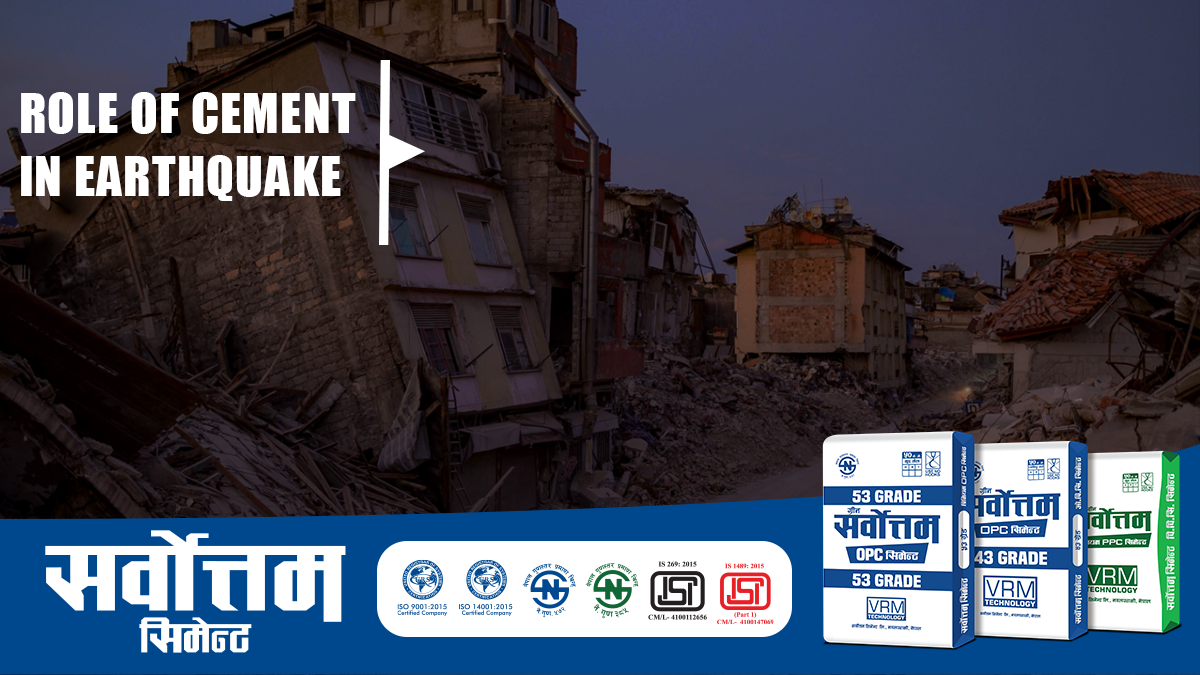
Role of Cement in Earthquake-Resistant Construction
Building Stronger, Safer Structures in Nepal
Nepal lies in one of the most seismically active regions in the world. The devastating 2015 Nepal earthquake demonstrated how vulnerable poorly constructed buildings can be. Since Nepal falls under a high seismic risk zone, earthquake-resistant construction is not a choice it is a necessity. While structural design, reinforcement detailing, and compliance with the Nepal Building Code (NBC) are critical, the foundation of every safe structure begins with one essential material: cement.
The quality of cement directly affects concrete strength, bonding capacity, durability, and overall seismic performance.
Understanding Earthquake Forces on Buildings
During an earthquake, buildings experience:
- Strong lateral (sideways) forces
- Rapid ground acceleration
- Cyclic vibration and repeated stress loading
- Push–pull stress reversals
- Shear forces at beam-column joints
These forces create tension and compression alternately within structural members. If the concrete lacks adequate compressive strength or proper bonding with reinforcement steel, cracks develop quickly leading to partial or complete structural failure. High-performance cement enhances concrete density, strength, and ductility, making structures more resistant to seismic damage.
How Cement Contributes to Earthquake-Resistant Construction
1. High Compressive Strength for Structural Stability
Concrete must resist crushing and compression during seismic movement. Superior cement
ensures:
- Higher compressive strength
- Stronger columns and beams
- Improved load distribution
- Reduced risk of brittle failure
For structural grades like M20, M25, and higher, consistent cement quality is essential. This is why builders look for the best strength cement in Nepal when constructing homes, commercial buildings, and infrastructure projects.
2. Strong Bonding with Steel Reinforcement
Earthquake-resistant buildings rely on reinforced concrete structures. The bond between cement concrete and steel rebars determines how effectively forces are transferred.
Premium cement improves:
- Adhesion to reinforcement
- Crack control
- Structural integrity under vibration
- Resistance to slippage during seismic movement
Strong bonding increases the ductility of reinforced concrete a key factor in seismic-resistant design.
3. Durability and Crack Resistance
Long-term durability is crucial in seismic regions. Weak or porous concrete allows moisture penetration, corrosion of steel, and micro-cracking.
Quality cement reduces:
- Shrinkage cracks
- Water permeability
- Chemical deterioration
- Internal micro-fractures
Dense concrete enhances structural lifespan and ensures buildings remain resilient for decades.
4. Controlled Setting and Uniform Performance
Uniform fineness and controlled chemical composition ensure:
- Predictable setting time
- Even hydration process
- Balanced early and long-term strength
- Reduced internal stress development
Consistency in production directly translates into consistent structural performance.
Why Sarbottam Cement Stands Out in Nepal
When searching for the best cement in Nepal, top cement in Nepal, or best strength cement in Nepal, quality assurance and technological advancement are critical factors.
First Cement Industry in Nepal to Introduce VRM Technology
Sarbottam Cement is the first cement industry in Nepal to introduce Vertical Roller Mill (VRM) technology.
VRM technology provides:
- Superior particle size distribution
- Higher fineness control
- Improved strength development
- Lower energy consumption
- Reduced environmental impact
This advanced grinding technology ensures better cement reactivity and enhanced performance in earthquake-resistant structures.
Own Limestone Mines for Raw Material Consistency
Sarbottam Cement operates with its own limestone mines, ensuring:
- Controlled raw material composition
- Stable chemical balance
- Reduced impurities
- Consistent long-term quality
Quality starts from the source. Controlled mining directly improves cement reliability.
Certified Under National and International Standards
Sarbottam Cement is:
- Certified under NS 572 (OPC)
- Certified under NS 385 (PPC)
- Compliant with ISO 9001 (Quality Management System)
- Compliant with ISO 14001 (Environmental Management System)
These certifications ensure standardized manufacturing, quality control, environmental responsibility, and consistent strength performance.
OPC vs PPC in Earthquake-Resistant Construction
OPC (Ordinary Portland Cement – NS 572)
- Higher early strength
- Ideal for structural elements
- Suitable for columns, beams, and foundations
- Recommended for fast-track construction
PPC (Portland Pozzolana Cement – NS 385)
- Improved long-term strength
- Better durability
- Reduced heat of hydration
- Enhanced resistance to cracking
Both OPC and PPC, when manufactured under strict quality control, contribute effectively to seismic-resistant concrete.
Earthquake Safety Requires a Complete System
While high-quality cement significantly improves structural reliability, earthquake-resistant construction depends on:
- Proper structural design
- Adequate reinforcement detailing
- Correct concrete mix design
- Skilled workmanship
- Compliance with Nepal Building Code
However, selecting technologically advanced, certified cement dramatically enhances safety margins.
Building a Disaster-Resilient Nepal
Nepal’s geography demands resilient infrastructure. Every home, commercial complex, bridge, and public building must prioritize structural strength and durability.
With:
- Advanced VRM technology
- Own limestone mines
- NS 572 and NS 385 certification
- ISO 9001 and ISO 14001 compliance
- Strict quality control processes
Sarbottam Cement stands among the top cement brands in Nepal for earthquake-resistant construction.
Frequently Asked Questions (FAQs)
1. Why is cement critical for earthquake-resistant buildings?
It determines concrete strength, bonding with steel, crack resistance, and overall seismic performance.
2. Which cement is best for earthquake-resistant construction in Nepal?
Certified OPC (NS 572) and PPC (NS 385) are both suitable depending on structural requirements.
3. How does VRM technology improve cement quality?
It enhances fineness control, particle distribution, and strength development for better structural performance.
4. Does stronger cement alone ensure earthquake safety?
No. Proper design, reinforcement, workmanship, and compliance with building codes are equally important.
5. Why are NS and ISO certifications important?
They ensure consistent quality, strength standards, and environmentally responsible manufacturing.


